IPv6 Takes Flight

|
by Craig Miller
On a recent flight, my interest was piqued when the flight attended announced on the PA that there would be free Wifi on the entire flight. Naturally, I took out my phone and connected to the in-flight Wifi, as almost everyone else on the plane did.
But I suspect that others on the plane didn't look at what addresses they had received from the in-flight Wifi. Looking at the addresses (with the HE app), not only did I have the usual RFC 1918 private IPv4 address, but I also had two global IPv6 addresses!
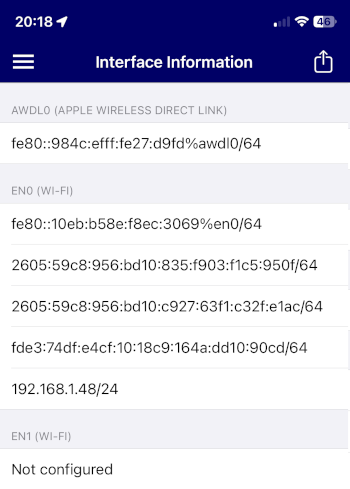
Checking IPv6 connectivity
Using the HE App's ping function, which can ping over IPv4 or IPv6, I tested the IPv6 connectivity while in flight. Not only did I have a global IPv6 address, but it actually could ping he.net. with a latency of 52 ms. A very good sign.
Looking a little deeper
Unlike the many NAT layers of IPv4 and private RFC 1918 addresses, it is possible to look up who is providing the IPv6 address by using whois. The iPhone doesn't allow CLI access, but again the HE App has a whois function, where I could enter the first two hextets of the address (think: first 32 bits) and see who has that address space.
Whois the Airline ISP?
Turns out 2605:59c8:: is registered to Starlink. I had heard that Starlink was being deployed on air planes in North America, but this was my first first-hand experience.
IPv6 in the Air
With global IPv6 deployment just under 50% (as measured by Google statistics), it is very refreshing to see IPv6 not only on the ground, but in the air as well.
Sadly, this was a short flight from Vancouver to Victoria (about 20 minutes), but it was still cool to have IPv6 along the way. The airlines are finally making it into the 21st century!
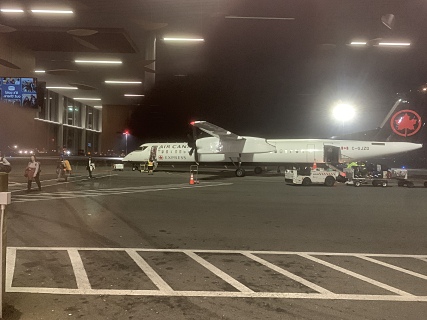
Notes:
- IPv6 Wings blueprint graphic by AI, deepai.org
- Air Canada Jazz - De Havilland Canada DHC-8
18 January 2026